
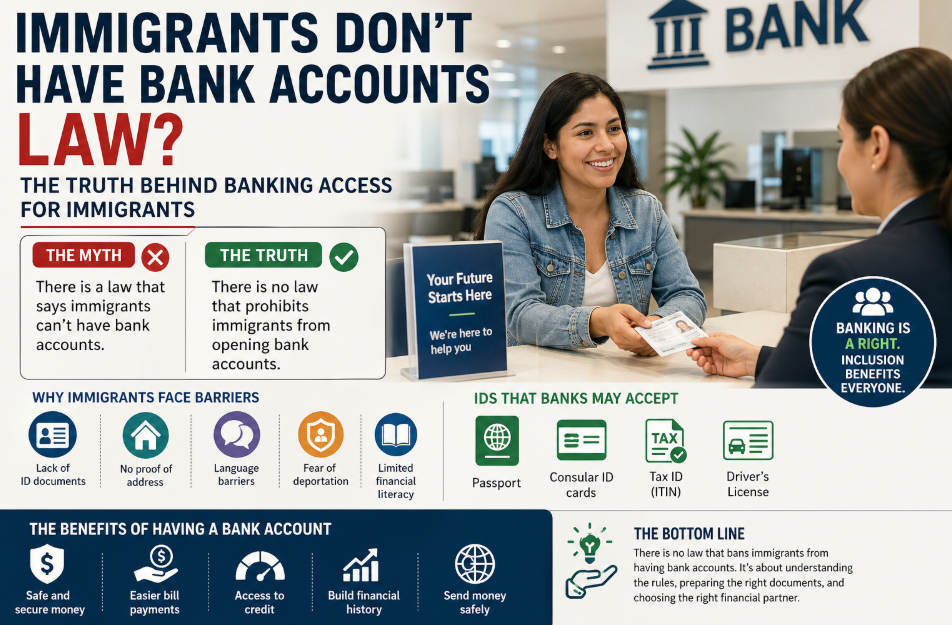
Introduction: Let’s Clear the Confusion Once and For All
If you’ve ever heard someone say, “Immigrants can’t have bank accounts because of the law,” you’re not alone. It’s one of those persistent myths that spreads like wildfire—half-truth, half misunderstanding, and a sprinkle of fear.
But here’s the reality: there is no universal law that prohibits immigrants from opening bank accounts.
So why does this belief exist? Why do so many immigrants still struggle to access basic financial services?
Let’s break it down together—step by step—so we can separate fact from fiction and uncover what’s really happening behind the scenes.
What People Mean by “Immigrants Don’t Have Bank Accounts Law”
The Misinterpretation of Financial Regulations
When people talk about a supposed law, they’re often referring to strict banking regulations—particularly those designed to prevent money laundering, fraud, and terrorism financing.
In countries like the United States, laws such as the Bank Secrecy Act and the USA PATRIOT Act require banks to verify customer identities.
But here’s the key point:
These laws don’t ban immigrants—they simply require proper identification.
Can Immigrants Legally Open Bank Accounts?
Short Answer: Yes, They Can
Most countries allow immigrants—documented or not—to open bank accounts, provided they meet certain requirements.
Long Answer: It Depends on the Bank and Country
Banks have discretion. While laws don’t prohibit immigrants, institutions may impose stricter policies.
Think of it like entering a club. The law says you can enter—but the bouncer (the bank) decides how strict the ID check is.
Why Do Some Immigrants Struggle to Open Accounts?
It’s Not About Legality—It’s About Barriers
Let’s look at the real obstacles:
- Lack of government-issued ID
- No proof of address
- Language barriers
- Fear of deportation
- Limited financial literacy
- Bank policies that vary widely
These barriers create the illusion of a “law,” when in reality, it’s more about access and trust.
Understanding KYC: The Real Gatekeeper
What Is KYC (Know Your Customer)?
KYC is a process banks use to verify identity.
It’s required globally and forms the backbone of financial compliance.
Why It Matters
Banks must:
- Confirm your identity
- Understand your financial activity
- Prevent illegal transactions
For immigrants without traditional documents, this can feel like hitting a brick wall.
Types of Identification Banks May Accept
Not All IDs Are Equal—but Many Work
Depending on the country and institution, immigrants can use:
- Passport (foreign or expired in some cases)
- Consular ID cards
- Tax identification numbers
- Driver’s licenses (local or international)
Some banks even accept alternative forms of ID—especially those targeting underserved communities.
Do Undocumented Immigrants Have Banking Rights?
Yes—But With Limitations
Undocumented immigrants are not explicitly banned from banking. However:
- Access is inconsistent
- Some banks refuse service
- Documentation requirements are stricter
Still, many institutions have begun to embrace financial inclusion.
Why Banks Are Cautious
It’s About Risk, Not Immigration Status
Banks fear:
- Regulatory penalties
- Fraud risks
- Compliance violations
Imagine walking a tightrope—one wrong move could cost millions in fines.
That’s why banks often play it safe.
The Role of Financial Inclusion Programs
A Shift Toward Accessibility
Governments and organizations are pushing for inclusion.
Programs aim to:
- Simplify account opening
- Accept alternative IDs
- Educate immigrant communities
This is slowly changing the landscape.
Countries Where Immigrants Can Open Bank Accounts Easily
Examples of More Inclusive Systems
Some countries lead the way:
- United States (with ITIN-based accounts)
- Canada
- United Kingdom
- Spain
- Germany
Each offers pathways—though the ease varies.
The Rise of Alternative Banking Solutions
When Traditional Banks Say No
Immigrants are turning to:
- Fintech apps
- Digital wallets
- Neobanks
These platforms often require less documentation and provide faster onboarding.
Benefits of Having a Bank Account for Immigrants
More Than Just Convenience
A bank account offers:
- Safe money storage
- Easier bill payments
- Access to credit
- Financial history building
- Reduced reliance on cash
It’s like moving from walking barefoot to wearing shoes—you suddenly have protection and freedom.
Risks of Being Unbanked
Why This Issue Matters
Without a bank account, immigrants face:
- Higher fees (check cashing services)
- Increased theft risk
- Limited financial growth
- Difficulty sending money abroad
Being unbanked can trap people in a cycle of financial vulnerability.
How Immigrants Can Improve Their Chances
Practical Steps That Make a Difference
Here’s what we recommend:
- Gather multiple forms of ID
- Open an ITIN (if applicable)
- Choose immigrant-friendly banks
- Start with basic accounts
- Seek help from community organizations
Small steps can open big doors.
Common Myths About Immigrants and Banking
Let’s Debunk Them Quickly
Myth 1: Immigrants are banned from banks
→ False
Myth 2: Only citizens can open accounts
→ False
Myth 3: Banks report immigration status
→ Generally false
Myth 4: You need a Social Security Number
→ Not always true
How Policy and Politics Influence Access
The Bigger Picture
While no law bans immigrants from banking, political climates can influence:
- Bank policies
- Public perception
- Access to services
It’s a subtle but powerful effect.
What the Future Looks Like
A More Inclusive Financial System?
We’re seeing:
- More digital banking options
- Relaxed ID requirements
- Increased awareness
The trend is clear: inclusion is growing, even if slowly.
Closing Thoughts: The Truth Behind the Myth
So, is there a law that says immigrants can’t have bank accounts?
No.
What exists instead is a complex web of regulations, bank policies, and practical barriers that can make access difficult—but not impossible.
If we zoom out, the story becomes clearer:
It’s not about prohibition—it’s about navigation.
And once you understand the system, you can start to work with it instead of feeling blocked by it.
FAQs
1. Can immigrants open bank accounts without a Social Security Number?
Yes, many banks accept an ITIN or alternative identification instead of a Social Security Number.
2. Do banks report undocumented immigrants to immigration authorities?
Generally, banks do not report immigration status, as their focus is financial compliance, not enforcement.
3. What is the easiest bank account for immigrants to open?
Basic checking accounts at immigrant-friendly banks or digital banks are usually the easiest.
4. Is it illegal for undocumented immigrants to have a bank account?
No, it is not illegal in most countries.
5. Why do banks ask for so many documents?
Because of regulations like anti-money laundering laws and identity verification requirements.