
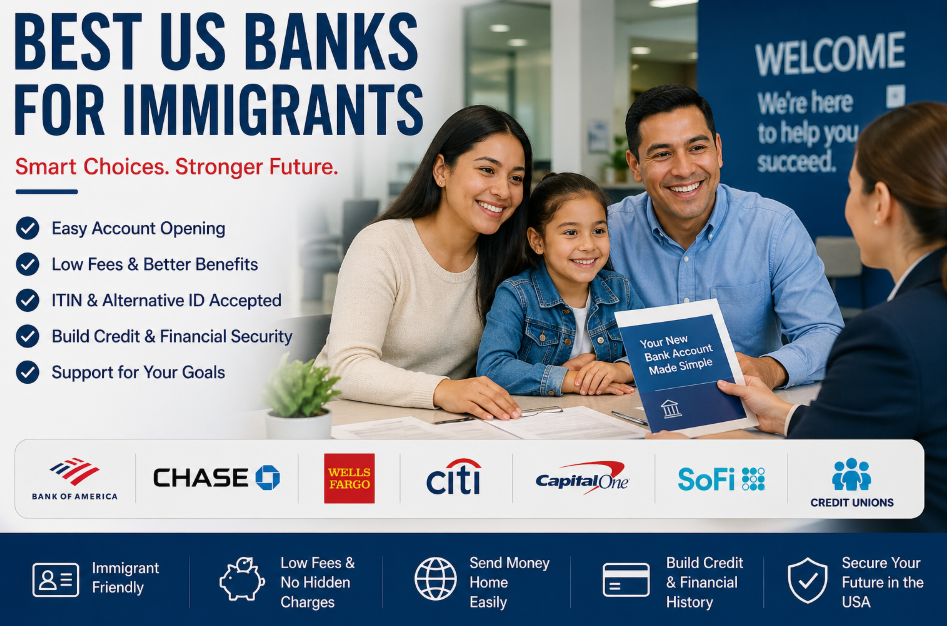
Moving to the United States can feel like landing in the middle of a fast-moving city with no map, no street signs, and everyone somehow knowing where to go. We need a place to live, a phone number, documents, work, transportation, and then—quietly sitting behind all of that—we need a bank account.
A U.S. bank account is not just a place to keep money. For many immigrants, it becomes the first real bridge into the American financial system. It helps us receive wages, pay rent, send money, build a financial record, avoid check-cashing fees, and slowly step into credit, savings, and long-term stability.
The good news? Many immigrants, non-U.S. citizens, international students, visa holders, new workers, and people without a Social Security number may still be able to open a U.S. bank account. The process depends on the bank, your documents, your address, and whether you apply online or in person. The CFPB explains that banks and credit unions generally verify your name, date of birth, address, and an identification number, which may include an SSN, ITIN, passport number, alien identification card number, or another government-issued ID number.
So, which are the best US banks for immigrants? Let’s walk through the options like we’re sitting at a kitchen table, comparing real-life choices instead of drowning in bank jargon.
Why Immigrants Need the Right US Bank
Not every bank fits every immigrant’s situation. Some banks are easier if we already have an SSN. Others are better if we only have an ITIN, foreign passport, consular ID, visa document, or proof of U.S. address. Some offer Spanish-language support. Some have many physical branches. Others are cheaper but more online-focused.
The best bank for an immigrant is usually the one that makes three things simple:
- Opening the account with available documents
- Avoiding monthly fees
- Managing money safely and conveniently
The FDIC says having a bank account can help people save on check-cashing fees, pay bills more cheaply, and build a financial relationship that may lead to other financial products later.
That last part matters. A bank account is often the first brick in the wall. Credit cards, car loans, apartment applications, business banking, emergency savings, and even mortgage dreams may start with one humble checking account.
Can Immigrants Open a Bank Account in the United States?
Yes, many immigrants can open a bank account in the U.S., but the exact requirements vary by institution. Some banks allow non-U.S. citizens to apply with alternative identification. Others may require an ITIN, proof of address, immigration documents, or an in-person branch visit.
Chase notes that non-residents opening a U.S. bank account may need identification, proof of address, and possibly an opening deposit, while also advising applicants to confirm documentation with the bank directly.
That means we should not assume every branch employee will handle the case the same way. One branch may understand consular IDs and ITINs. Another may ask for more documents. It is annoying, yes, but normal.
Common Documents Immigrants May Need
Most banks may ask for some combination of:
- Foreign passport
- U.S. visa or immigration document
- Green Card or Employment Authorization Document
- ITIN or SSN
- Consular ID, such as matrícula consular
- Proof of U.S. address
- Lease agreement, utility bill, school letter, employer letter, or bank statement
- Opening deposit, depending on the account
Bank of America, for example, lists foreign passports, certain nonimmigrant visa and border crossing cards, and consular IDs from countries including Mexico, Guatemala, Dominican Republic, and Colombia among examples of primary photo ID for certain account applications.
What If We Do Not Have a Social Security Number?
Not having an SSN does not automatically close the door. Some banks accept an ITIN instead. Others may accept a passport number or other government-issued identification number depending on the account and branch policy.
The CFPB’s account-opening checklist specifically notes that an identification number may be an SSN, ITIN, passport number with country of issuance, alien identification card number, or another government-issued identification number.
Still, online applications can be stricter. If we do not have an SSN, an in-person branch visit often gives us a better chance because a banker can review documents manually.
Best US Banks for Immigrants: Quick Comparison
Before we dive deeper, here is a practical snapshot.
| Bank or Institution | Best For | Why It Works for Immigrants |
|---|---|---|
| Bank of America | New arrivals, students, workers | Strong branch network and immigrant-focused account pages |
| Chase | Branch access and everyday banking | Publishes non-resident banking guidance and accepts several ID types |
| Wells Fargo | People with ITIN or alternative ID | Clear ID guidance for non-U.S. citizens |
| Citi | International-minded immigrants | Global name, accepts passport as ID in general account guidance |
| Capital One | Low-fee digital banking | No monthly fees or minimums on 360 Checking, but may be better for those with stronger U.S. documentation |
| SoFi | Online banking with ITIN option | Lists SSN or ITIN in eligibility information |
| Local credit unions | Community support | Some serve immigrant communities with bilingual help and alternative ID policies |
| Juntos Avanzamos credit unions | Hispanic and immigrant communities | Designation recognizes credit unions serving Hispanic and immigrant consumers |
Now let’s unpack each one.
Bank of America: Best Overall Big Bank for New Immigrants
Bank of America is one of the strongest options for immigrants because it actively publishes information for people new to banking in the U.S., including international students and professionals. That matters because we do not want to walk into a branch and feel like we are explaining our entire life story from scratch.
Bank of America says non-residents, international students, and international professionals can begin the process of opening a U.S. bank account through its international banking pages.
Why Bank of America Works Well
Bank of America is a good fit if we want:
- A large national branch network
- In-person support
- Spanish-language resources
- Options for international students and new professionals
- Clear examples of acceptable foreign documents
For immigrants who are still learning how U.S. banking works, a physical branch can be comforting. Sometimes we need to ask, “Can I use this document?” or “Will this address work?” A real person can help in a way an online form cannot.
Documents Bank of America May Accept
Bank of America’s application FAQ mentions proof of U.S. residency, one primary photo ID, and one secondary ID. Examples of primary photo ID include a foreign passport, certain U.S. nonimmigrant visa/border crossing cards, Canadian citizenship card, and consular IDs from Mexico, Guatemala, Dominican Republic, or Colombia.
That is especially useful for Latin American immigrants who may already have a consular ID.
Best Bank of America Account Type for Immigrants
For many newcomers, the best starting point is a basic checking account. We should look for:
- Low monthly maintenance fee
- Easy fee waiver
- Debit card access
- Zelle or transfer options
- Online and mobile banking
- No complicated balance requirement
The smart move is to ask the branch: “Which checking account is easiest to maintain with low or no fees based on my situation?”
Chase: Best for Branch Access and Everyday Convenience
Chase is another strong candidate because it has a huge U.S. presence and clear educational material for non-residents. For immigrants who want a mainstream bank with lots of ATMs and branches, Chase can be practical.
Chase explains that non-residents may need identification, proof of address, and possibly an opening deposit, and that requirements may vary by bank.
Why Chase Can Be a Good Choice
Chase may be ideal if we value:
- Lots of branches in major U.S. cities
- A widely used mobile app
- Strong ATM access
- Everyday checking options
- Easy transfers between friends and family
- Business banking options later
If we are new to the U.S. and living in a city like New York, Miami, Chicago, Los Angeles, Houston, Dallas, or Phoenix, Chase may be nearby. That convenience matters more than people admit. A bank that is “technically better” but has no branch near us may become a headache.
Chase ID Options for Non-U.S. Citizens
Chase’s acceptable identification document says that for non-U.S. permanent residents without a Green Card, acceptable identification may include a matrícula consular card, passport with photo, or U.S. Employment Authorization Card, with additional rules such as an ID containing a U.S. address.
This does not mean every applicant will be approved automatically. But it does show that Chase has published ID pathways for non-U.S. citizens.
When Chase May Not Be Perfect
Chase may not be the best choice if we cannot meet fee-waiver requirements. Big banks often have monthly fees unless we maintain a minimum balance, receive direct deposits, or qualify for student-style waivers.
So, before opening an account, we should ask:
- What is the monthly fee?
- How can I avoid it?
- Do I need direct deposit?
- Is there a minimum balance?
- Can I open with my current documents?
A bank account should feel like a tool, not a tiny leak in our wallet.
Wells Fargo: Best for Clear ITIN and Alternative ID Guidance
Wells Fargo is worth considering because it provides detailed identification guidance for opening an Everyday Checking account.
Wells Fargo says applicants should know their SSN or ITIN and have two forms of identification. It also states that non-U.S. citizens without a U.S.-issued taxpayer identification number must provide a government-issued ID that gives evidence of nationality or residence.
Why Wells Fargo Works for Some Immigrants
Wells Fargo may be useful if we have:
- ITIN instead of SSN
- Foreign government ID
- Need for in-person banking
- Preference for a large national bank
- Access to a nearby branch
Its account-opening pages are direct about documentation, which helps us prepare before walking into a branch.
Wells Fargo Account Considerations
Wells Fargo offers different checking products, including options with minimum opening deposits and accounts designed to avoid overdraft fees. Its checking page lists Clear Access Banking as a checkless account with no overdraft fees and Everyday Checking with a $25 minimum opening deposit.
For immigrants who are just starting out, overdraft fees can be dangerous. One small mistake can turn into a stack of charges. A checkless, no-overdraft-style account may be safer if we are still learning the system.
Best For
Wells Fargo is best for immigrants who want a traditional bank, can visit a branch, and have either an ITIN or acceptable government-issued ID.
Citi: Best for Internationally Minded Immigrants
Citi can be attractive for immigrants with international ties because it is a globally recognized bank. It may not be the easiest bank for every newcomer, but it can be a strong option for people who value international banking familiarity.
Citi’s general account-opening guidance says a valid government-issued ID can include a driver’s license, state ID, or passport, and that some banks may require an SSN while banks that do not require one may request additional forms of identification.
Why Citi May Appeal to Immigrants
Citi may be useful if we want:
- A bank with international recognition
- Online and mobile banking
- Checking and savings options
- A familiar name for people coming from countries where Citi has presence
- Potential access to premium banking later
Citi Account Opening Details
Citi says checking account applications may require basic information such as address and tax identification number, and that personal information may include name, address, and SSN or ITIN. Citi also states that no minimum deposit is needed to open any Citi checking account, though funding the account is still a good idea.
Best For
Citi is best for immigrants who have stronger documentation, want a global banking brand, and are comfortable checking requirements before applying.
Capital One: Best Low-Fee Option for Immigrants With Stronger Documentation
Capital One 360 Checking is not always the easiest first account for immigrants without U.S. documentation because online banks can be stricter with identity verification. However, once we have the right documents, it can be excellent because of its low-fee structure.
Capital One says 360 Checking has no monthly fees, no minimum balance to open, keep, or use the account, and no overdraft fees.
Why Capital One Is Attractive
Capital One may be great if we want:
- No monthly maintenance fees
- No minimum balance stress
- Strong mobile banking
- A simple checking account
- Fee-free ATM access
- Less pressure to keep a large balance
For immigrants working hourly jobs, gig jobs, or inconsistent schedules, “no minimum balance” can be a relief. We do not want a bank punishing us because rent week arrived before payday.
Where Capital One May Be Harder
Because Capital One is more digital-first, applicants may need to pass online identity checks. If our credit file is thin, address history is new, or documents are not easily verified online, approval may be harder than at a physical branch.
Best For
Capital One is best for immigrants who already have a stable U.S. address, SSN or ITIN, and enough identity history to pass online verification.
SoFi: Best Online Bank for Immigrants With SSN or ITIN
SoFi can also be a good digital option for immigrants who have the necessary documentation. Its support page says applicants for SoFi Checking and Savings need personal information including a physical U.S. address, citizenship status, and an SSN or ITIN.
Why SoFi May Work
SoFi may appeal to immigrants who want:
- Online-first banking
- Checking and savings in one place
- ITIN eligibility
- Digital tools
- No traditional branch visits
- A modern app-based experience
When SoFi Is Not Ideal
SoFi is not ideal if we need in-person help, have difficulty verifying documents online, or do not yet have a stable U.S. residential address.
For many immigrants, a branch bank is better first. Then, once life is more settled, an online bank can become the second account for savings, budgeting, or higher-yield features.
Local Credit Unions: Best for Community-Based Support
Credit unions can be hidden gems. They are not always flashy. They may not have giant skyscraper logos or Super Bowl ads. But for immigrants, some local credit unions can feel more human.
A credit union is a member-owned financial institution. Many serve specific regions, employers, communities, or membership groups. Some are more flexible than large banks with alternative IDs, especially in immigrant-heavy communities.
Why Credit Unions Can Be Immigrant-Friendly
Credit unions may offer:
- Lower fees
- Smaller opening deposits
- Bilingual staff
- Community education
- ITIN lending options
- More personal service
- Alternative ID acceptance
Inclusiv’s Juntos Avanzamos designation recognizes credit unions dedicated to serving and empowering Hispanic and immigrant communities through affordable products, bilingual support, and culturally relevant solutions.
That is a big signal. If we see a Juntos Avanzamos credit union nearby, it is worth calling.
Juntos Avanzamos Credit Unions
Juntos Avanzamos credit unions are especially important for Hispanic and immigrant communities. The designation is not just a nice phrase; it points to institutions trying to serve people who may feel ignored by mainstream finance.
Some designated credit unions describe their role as helping Latino and immigrant consumers navigate the U.S. financial system while offering safe, affordable, and relevant financial services.
Best For
Credit unions are best for immigrants who want community support, bilingual help, lower fees, and a more personal experience.
Best US Banks for Immigrants Without SSN
If we do not have an SSN, our best options are usually:
1. Bank of America
Strong because it lists several foreign and consular ID examples and has international newcomer resources.
2. Chase
Good because it publishes non-resident guidance and acceptable ID examples for non-U.S. citizens.
3. Wells Fargo
Useful because it clearly discusses ITINs and non-U.S. citizen ID requirements.
4. Citi
Potentially good for people with passport, ITIN, and address documentation.
5. Juntos Avanzamos Credit Unions
Often excellent for immigrants who need bilingual support and alternative ID flexibility.
The key is this: without an SSN, we should expect to apply in person more often than online. Bring original documents, not photos on a phone. Dress the process like a paperwork appointment, not a casual errand.
Best US Banks for Immigrants With ITIN
An ITIN can make the process smoother because it gives banks a tax identification number to use. It is not the same as an SSN, but many banks can work with it.
Best options for immigrants with ITIN include:
- Bank of America
- Chase
- Wells Fargo
- Citi
- SoFi
- Local credit unions
SoFi specifically lists SSN or ITIN in its eligibility information, while Wells Fargo says applicants should know their SSN or ITIN when opening an Everyday Checking account.
Why ITIN Helps
An ITIN may help with:
- Opening deposit accounts
- Tax reporting
- Identity verification
- Building a financial footprint
- Applying for some credit products later
But remember: an ITIN does not guarantee approval. Banks still review identity, address, risk rules, and documentation.
Best US Banks for International Students
International students often need a bank account quickly. Tuition payments, rent, part-time jobs, and daily spending all become easier with U.S. banking.
Best options include:
Bank of America for International Students
Bank of America has specific pathways for international students and people new to the U.S.
Chase for Campus and City Access
Chase can be convenient for students in large cities or near campuses, especially where branches and ATMs are easy to find.
Wells Fargo for Branch Support
Wells Fargo can work well when students have passports, school documents, proof of address, and possibly an ITIN or other acceptable ID.
Student Document Checklist
International students should bring:
- Passport
- Student visa
- I-20 or DS-2019
- School acceptance or enrollment letter
- U.S. address proof
- Student ID
- ITIN or SSN if available
- Opening deposit
Best US Banks for Spanish-Speaking Immigrants
For Spanish-speaking immigrants, the best bank is not only about fees. Language matters. A bank visit is stressful enough without translating every sentence in our head.
Strong choices include:
- Bank of America
- Wells Fargo
- Chase
- Local Hispanic-serving credit unions
- Juntos Avanzamos credit unions
Bank of America offers Spanish-language resources for non-residents opening U.S. bank accounts, which can make the process easier for Spanish-speaking newcomers.
Why Language Support Matters
Banking words can be tricky:
- Overdraft
- Maintenance fee
- Minimum balance
- Wire transfer
- Direct deposit
- Account closure
- Returned payment
- Insufficient funds
One misunderstood fee can cost money. One misunderstood document request can delay an account. Language support is not decoration; it is protection.
How to Choose the Best Bank as an Immigrant
The best bank is not always the biggest bank. It is the bank that fits our documents, habits, city, income, and goals.
Step 1: Start With Your Documents
Ask yourself:
- Do I have an SSN?
- Do I have an ITIN?
- Do I have a passport?
- Do I have a consular ID?
- Do I have proof of U.S. address?
- Do I have a visa, EAD, Green Card, or school document?
If the answer is “not yet” to some of these, choose a bank or credit union known for alternative documentation.
Step 2: Compare Fees Like a Hawk
Monthly fees are like tiny mosquitoes. One is annoying. Twelve months of them can drain real money.
Look for:
- No monthly fee
- Easy fee waiver
- No overdraft fee
- Free debit card
- Free ATM network
- Low wire transfer costs
- Low minimum opening deposit
The FDIC notes that many insured banks offer accounts with low or no monthly maintenance fees when customers have direct deposit or maintain a minimum balance.
Step 3: Decide Between Branch and Online Banking
If we are new to the U.S., a branch can be very useful. If we are already settled, online banking may save fees.
Choose a branch bank if:
- Your documents are unusual
- You need Spanish support
- You do not have an SSN
- You want face-to-face help
Choose online banking if:
- You have SSN or ITIN
- You have a stable U.S. address
- You want low fees
- You are comfortable with apps
What to Ask Before Opening the Account
Before signing anything, ask the banker these questions:
- Can I open this account with my current documents?
- What is the monthly fee?
- How do I avoid the monthly fee?
- Is there a minimum balance?
- Is there an opening deposit?
- Are there overdraft fees?
- Can I send international transfers?
- Will I receive a debit card?
- Can I use Zelle?
- Can I open a savings account too?
- What happens if my address changes?
- Can I get statements for proof of address later?
A bank account should be clear. If the explanation feels foggy, slow down.
Common Mistakes Immigrants Should Avoid
Opening the First Account Without Checking Fees
Never open an account just because the bank is famous. Big-name banks can still charge monthly fees if we do not meet waiver rules.
Applying Online When Documents Are Complicated
If we lack an SSN or have a short U.S. address history, online applications may fail. A branch visit may work better.
Ignoring Credit Unions
Some immigrants only think of big banks. But local credit unions may be more flexible and community-focused.
Using Check-Cashing Stores Too Long
Check-cashing stores may feel convenient, but the costs add up. A bank account can help us keep more of our own money.
Not Keeping Documents Updated
If we move, update the bank. If our ID expires, renew it. If the bank asks for information, respond carefully and directly through official bank channels.
Best Bank by Immigrant Situation
New Arrival With Passport and U.S. Address
Best options: Bank of America, Chase, Wells Fargo, Citi.
Immigrant With ITIN but No SSN
Best options: Wells Fargo, Bank of America, Chase, Citi, SoFi, credit unions.
Spanish-Speaking Newcomer
Best options: Bank of America, Wells Fargo, Chase, Juntos Avanzamos credit unions.
International Student
Best options: Bank of America, Chase, Wells Fargo.
Immigrant Who Wants Lowest Fees
Best options: Capital One, SoFi, local credit unions, Bank On-style low-fee accounts.
Immigrant Who Needs Personal Help
Best options: Local credit unions, Bank of America, Chase, Wells Fargo.
Our Recommended Ranking: Best US Banks for Immigrants
1. Bank of America
Best overall because of its newcomer resources, foreign ID examples, branch access, and Spanish-language support.
2. Chase
Best for convenience, branch access, and everyday banking in major U.S. cities.
3. Wells Fargo
Best for clear ITIN and non-U.S. citizen identification guidance.
4. Juntos Avanzamos Credit Unions
Best community-based option for Hispanic and immigrant families.
5. Citi
Best for immigrants who value an international banking brand and have solid documentation.
6. Capital One
Best low-fee digital option for immigrants with stronger U.S. documentation.
7. SoFi
Best online option for immigrants with SSN or ITIN who do not need branch service.
Final Thoughts: The Best Bank Is the One That Lets Us Move Forward
Choosing the best US bank for immigrants is not about chasing the fanciest app or the biggest logo. It is about finding a financial home that accepts our documents, respects our situation, keeps fees low, and helps us build the next chapter.
For many immigrants, Bank of America, Chase, and Wells Fargo are strong first stops because they have branches, published document guidance, and experience with non-U.S. citizens. Citi can be helpful for internationally minded customers. Capital One and SoFi can be excellent once our documentation is strong enough for online verification. And local credit unions—especially Juntos Avanzamos credit unions—may offer the warmth and flexibility that big banks sometimes lack.
We should think of the first bank account like planting a small tree. At first, it is just a debit card, a routing number, and a place for paychecks. But over time, it can grow into savings, credit, stability, and choices. And choices, for an immigrant building life in a new country, are everything.
FAQs About the Best US Banks for Immigrants
Can immigrants open a bank account in the US without an SSN?
Yes, many immigrants may be able to open a bank account without an SSN. Some banks accept an ITIN, passport number, consular ID, alien identification number, or other government-issued identification number, depending on the bank’s policy and the account type.
Which bank is best for immigrants without a Social Security number?
Bank of America, Chase, Wells Fargo, Citi, and some local credit unions are often good places to start. For Spanish-speaking or Hispanic immigrants, Juntos Avanzamos credit unions may also be especially helpful because they focus on immigrant and Hispanic communities.
Can I open a US bank account with only a passport?
Sometimes, but not always. A passport may be accepted as a primary ID, but many banks also ask for proof of U.S. address, a secondary ID, an ITIN or SSN, immigration documents, or an opening deposit. Citi, for example, lists passport as a valid government-issued ID example in its general guidance.
Is a credit union better than a bank for immigrants?
A credit union can be better if we want lower fees, community support, bilingual service, and more flexible documentation policies. However, big banks may offer more branches, ATMs, and digital features. The best choice depends on our documents, location, and banking habits.
What is the easiest way for an immigrant to open a bank account?
The easiest way is usually to gather original documents, choose a bank known for working with non-U.S. citizens, call the branch first, and apply in person. Bring a passport, ITIN or SSN if available, proof of U.S. address, immigration or school documents, and a small opening deposit if required.