
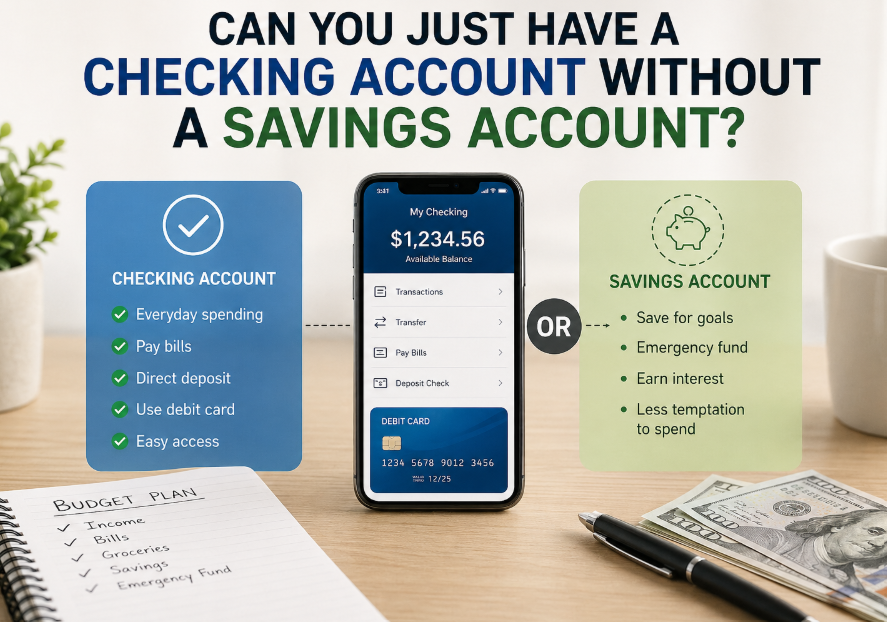
Yes, you can absolutely have a checking account without a savings account. In fact, many people start their banking journey with only a checking account because it handles the everyday money stuff: getting paid, paying bills, using a debit card, sending transfers, and withdrawing cash.
But here’s the bigger question: should we only have a checking account?
That answer depends on how we manage money, how often we save, whether we want emergency funds separated from spending money, and whether we care about earning interest. A checking account can work perfectly well on its own, but it can also become a messy financial drawer where everything gets tossed in together: rent money, grocery money, fun money, and “please don’t touch this” emergency money.
So, let’s walk through it clearly. No confusing banking language. No stiff financial lecture. Just a practical, human guide to whether we can live with checking only — and when adding savings might make life easier.
What Is a Checking Account?
A checking account is a bank account designed for everyday transactions. Think of it as the wallet of your financial life. It is where money comes in and goes out regularly.
We usually use a checking account for:
- Direct deposit from work
- Paying rent or mortgage
- Paying utilities
- Buying groceries
- Using a debit card
- Withdrawing cash from ATMs
- Sending money to friends or family
- Paying subscriptions
- Making online purchases
A checking account is built for movement. Money flows through it like traffic on a busy road. That is exactly what makes it useful.
Why Checking Accounts Are So Common
Checking accounts are popular because they make daily money management simple. Instead of carrying cash everywhere or paying bills manually, we can use a debit card, automatic payments, mobile banking, and transfers.
For many people, a checking account is the first real banking product they open. It feels practical. It gives access. It makes adult life easier.
Can a Checking Account Hold All Your Money?
Technically, yes. A checking account can hold your spending money, bill money, emergency money, and extra cash. There is no banking rule that says we must also open a savings account.
But just because we can keep everything in checking does not always mean it is the best system. A checking-only setup can be simple, but it can also make it easier to overspend because all the money is visible and available.
What Is a Savings Account?
A savings account is designed to store money we do not plan to spend immediately. If checking is the wallet, savings is more like a safe drawer.
We typically use savings accounts for:
- Emergency funds
- Vacation savings
- Car repairs
- Medical expenses
- House deposits
- School costs
- Big purchases
- Rainy-day money
Savings accounts usually are not meant for constant transactions. They are meant to help money sit quietly and grow, even if only a little.
Why Savings Accounts Exist
Savings accounts help separate money emotionally and practically. When emergency money is mixed with spending money, it becomes dangerously easy to treat it like available cash.
A separate savings account creates a small mental fence. It says, “This money has a job.”
That tiny separation can make a huge difference.
Do You Need a Savings Account to Open Checking?
Usually, no. Most banks, credit unions, and online banks allow customers to open a checking account by itself. Some institutions may offer a checking-and-savings bundle, but that does not mean the savings account is mandatory.
A checking account can stand alone.
Can You Just Have a Checking Account Without a Savings Account?
Yes, you can just have a checking account without a savings account. Banks generally do not require you to maintain both. If you only need a place to receive income, pay bills, and use a debit card, a checking account may be enough.
But we should look at the full picture.
Having only checking can work well when:
- You are just starting out financially
- You do not have much extra money to save yet
- You prefer simple banking
- Your checking account has no monthly fees
- You manage your budget carefully
- You use another place for savings, such as cash, investment accounts, or digital wallets
- You do not mind keeping all money in one place
Still, there are trade-offs.
Why Someone Might Only Want a Checking Account
Not everyone wants multiple accounts. Sometimes, simple is better. If managing finances already feels like juggling flaming bowling pins, adding more accounts can seem unnecessary.
Simpler Money Management
One account means one balance to track. No transfers. No account juggling. No wondering which account has what.
For people who like simplicity, one checking account can feel clean and manageable.
Fewer Fees to Worry About
Some savings accounts may have minimum balance requirements or conditions attached. While many modern banks offer free savings accounts, not all do.
If we are trying to avoid fees, opening only a free checking account may feel safer.
Easier Access to Money
Checking accounts are designed for access. We can use debit cards, checks, ATM withdrawals, online payments, and transfers.
Savings accounts are usually less convenient for direct spending. That is intentional, but some people do not want that extra barrier.
Low Income or Tight Budget
If every dollar already has a job before payday arrives, a savings account might feel pointless at first.
When money is tight, the priority may simply be:
- Receive paycheck
- Pay bills
- Buy food
- Avoid overdraft
- Make it to the next payday
In that case, checking alone may be enough for the moment.
The Benefits of Having Only a Checking Account
A checking-only setup can be perfectly reasonable. It is not “wrong.” It can even be smart in certain situations.
You Keep Banking Simple
The biggest advantage is simplicity. One account. One card. One balance. One login.
No mental clutter.
You Avoid Unnecessary Products
Banks sometimes encourage customers to open multiple accounts, but we do not always need every product offered. If a savings account does not serve a real purpose yet, skipping it can be practical.
You Can Still Budget Inside Checking
A savings account is helpful, but it is not the only way to budget. We can still use:
- Budgeting apps
- Spreadsheets
- Notes
- Envelope budgeting
- Separate categories inside some banking apps
- Automatic bill reminders
The account does not create discipline by itself. Our system does.
You Can Add Savings Later
Choosing checking only today does not lock us into that setup forever. We can open a savings account later when our income, goals, or comfort level changes.
Banking is not a tattoo. It is more like furniture. We can rearrange it.
The Downsides of Having Only a Checking Account
Now let’s be honest. Keeping everything in checking can create problems, especially if we are trying to save money or avoid accidental spending.
It Is Easier to Spend Your Savings
When all money sits in checking, it looks available. That can trick the brain.
Let’s say we have $2,000 in checking. It feels like we have $2,000 to use. But maybe $900 is for rent, $250 is for utilities, $300 is for groceries, and $400 is supposed to stay untouched for emergencies.
Without separation, the balance can lie to us.
You May Earn Little or No Interest
Many checking accounts pay no interest or very little interest. Savings accounts, especially high-yield savings accounts, may offer better interest rates.
No, interest will not magically make us rich overnight. But money sitting in checking often works like a parked car with the engine off. Money in savings may at least roll forward slowly.
Emergency Money Is Less Protected From Impulse Spending
Life happens. We see a sale. We order food. We upgrade a phone. We say, “I’ll put it back next month.”
Then next month arrives wearing boxing gloves.
A separate savings account helps reduce temptation because the money is not sitting directly beside our spending cash.
Budgeting Can Become Confusing
A checking account is busy. Payments come in and out constantly. If savings money is mixed into that traffic, it can be hard to know what is truly safe to spend.
A separate savings account works like a quiet room away from the noise.
Checking Account vs Savings Account
Checking and savings accounts are both useful, but they serve different purposes.
Main Purpose
A checking account is for spending and transactions.
A savings account is for storing and protecting money for future needs.
Access
Checking accounts usually provide fast access through debit cards, ATMs, checks, transfers, and bill pay.
Savings accounts usually provide access too, but they are not meant for constant spending.
Interest
Checking accounts often pay little or no interest.
Savings accounts often pay more interest, especially if they are high-yield savings accounts.
Best Use
Checking is best for everyday money.
Savings is best for money we want to keep separate.
Is It Bad to Only Have a Checking Account?
No, it is not bad to only have a checking account. It depends on our situation.
It may be completely fine if we are:
- New to banking
- Living paycheck to paycheck
- Trying to avoid account fees
- Using another savings method
- Comfortable managing money in one account
- Not ready to build savings yet
But if we regularly have extra money left over, want to build an emergency fund, or struggle with spending, a savings account can be very helpful.
When a Checking Account Alone Makes Sense
There are times when having only checking is practical.
You Are Opening Your First Bank Account
If we are new to banking, starting with checking is normal. It gives us the basic tools we need.
Once we understand deposits, debit cards, transfers, and bill pay, we can add savings later.
You Have No Extra Money to Save Yet
There is no shame in this. A savings account is useful, but survival comes first.
If every dollar is needed for essentials, the best step may be learning to manage checking well before adding more accounts.
You Already Save Somewhere Else
Some people keep savings in:
- Money market accounts
- Certificates of deposit
- Investment accounts
- Cash envelopes
- Prepaid systems
- Digital banking tools
A traditional savings account is not the only possible parking space for money.
You Want Maximum Simplicity
Some people thrive with fewer moving parts. If one account helps us stay organized, that matters.
Personal finance should fit real life, not just textbook advice.
When You Should Consider Adding a Savings Account
A savings account becomes useful when we want more structure.
You Want an Emergency Fund
Emergency money should not feel like spending money. A savings account gives it a separate home.
Even a small emergency fund can help with:
- Car repairs
- Medical bills
- Phone replacement
- Lost income
- Urgent travel
- Home repairs
Life loves surprises. Savings gives us a cushion.
You Struggle With Overspending
If money burns a hole in our pocket, keeping everything in checking may not be ideal.
Moving money into savings creates friction. And sometimes friction is our friend.
You Are Saving for Specific Goals
A savings account helps us separate goals like:
- Holiday gifts
- Vacation
- Moving costs
- School fees
- Wedding expenses
- Car down payment
- New laptop
When money has a label, it is harder to waste.
You Want to Earn Interest
If we have extra cash sitting in checking, a savings account may help it earn more. This is especially true with online banks that offer high-yield savings accounts.
Can You Have Multiple Checking Accounts Instead?
Yes, we can have multiple checking accounts instead of a savings account. Some people use separate checking accounts for different purposes.
For example:
- One checking account for bills
- One checking account for spending
- One checking account for business income
- One checking account for subscriptions
This can work well, especially if the accounts have no monthly fees.
Is Multiple Checking Better Than Checking Plus Savings?
Not always. Multiple checking accounts can help organize money, but they may not offer the same interest or savings-focused features.
A checking account is still designed for spending. A savings account is designed for storing.
The difference is subtle but important.
Can You Use a Checking Account as a Savings Account?
Yes, you can use a checking account as a savings account, but it is not always ideal.
If you keep extra money in checking and do not touch it, that money is technically saved. The problem is temptation and organization.
The “One Big Balance” Problem
One big checking balance can make us feel richer than we are.
Imagine opening your banking app and seeing $3,500. Nice, right?
But then we remember:
- $1,400 is rent
- $600 is bills
- $500 is groceries
- $300 is transportation
- $400 is emergency money
- $300 is actually available
Suddenly, $3,500 becomes $300 wearing a costume.
That is the danger.
How to Manage Money With Only a Checking Account
If we decide to use only a checking account, we need a strong system. The account itself will not organize our money for us.
Track Your Real Available Balance
Do not rely only on the number shown in the banking app. That balance may not include upcoming bills or pending payments.
We can calculate a “safe-to-spend” number:
Simple Safe-to-Spend Formula
Available balance minus upcoming bills minus money we do not want to touch equals safe-to-spend money.
Example:
- Checking balance: $1,200
- Upcoming rent: $700
- Utilities: $120
- Groceries: $180
- Emergency cushion: $100
Safe-to-spend amount: $100
That is the number that matters.
Use Notes or Budget Categories
If your bank app lets you create categories, use them. If not, a simple note on your phone can work.
For example:
- Rent: $900
- Food: $300
- Gas: $120
- Phone: $60
- Emergency: $200
- Spending: $150
This keeps the balance from becoming one blurry puddle.
Keep a Minimum Cushion
A checking cushion is money we do not spend. It helps avoid overdrafts and surprise charges.
Even a small cushion can help. Start with whatever is realistic.
Turn On Alerts
Most banks allow balance alerts. These can warn us when the account drops below a certain amount.
Useful alerts include:
- Low balance alert
- Large transaction alert
- Direct deposit alert
- Debit card purchase alert
- Bill payment alert
Alerts are like little financial smoke detectors.
How Much Money Should You Keep in Checking?
There is no perfect number, but a good rule is to keep enough for regular monthly expenses plus a small cushion.
For many people, checking should include:
- Monthly bills
- Regular spending money
- A buffer to avoid overdraft
- Money needed before the next paycheck
Extra money beyond that may be better placed in savings.
Common Checking Account Cushion
A cushion could be:
- $50 if money is tight
- $100 to $300 for basic protection
- One month of expenses for extra comfort
The right amount depends on income, bills, and spending habits.
Should Your Emergency Fund Be in Checking?
Usually, no. Emergency funds are often better kept in a savings account because they are separated from everyday spending.
But if checking is the only account we have, we can still keep emergency money there. We just need to clearly mark it mentally or in a budget.
Emergency Fund in Checking: Best Practices
If we keep emergency money in checking:
- Do not count it as spending money
- Track it separately
- Set a minimum balance rule
- Avoid dipping into it for non-emergencies
- Rebuild it quickly after using it
The goal is not perfection. The goal is protection.
Can a Bank Force You to Open Savings?
Most of the time, no. A bank generally cannot force you to open a savings account just to have checking unless the specific product is packaged that way.
Some banks may offer relationship accounts, bundles, or promotional packages. But many checking accounts can be opened alone.
Watch for Bundled Offers
Banks may say something like:
- “Open checking and savings together”
- “Get a bonus with both accounts”
- “Avoid fees with combined balances”
- “Enjoy relationship banking benefits”
These offers may be useful, but they are not always necessary.
Read the terms before agreeing.
Is a Checking Account Enough for Direct Deposit?
Yes. A checking account is usually enough for direct deposit. Employers commonly deposit paychecks into checking accounts.
We normally need:
- Bank routing number
- Checking account number
- Account type
- Possibly a voided check or direct deposit form
A savings account is not required for direct deposit, though some people choose to split direct deposit between checking and savings.
Can You Pay Bills With Only Checking?
Yes. Checking accounts are built for bill payments.
We can pay bills using:
- Debit card
- ACH transfer
- Online bill pay
- Checks
- Automatic withdrawals
- Payment apps linked to checking
This is one of the main reasons checking accounts exist.
Can You Build Financial Stability Without Savings?
This is where we need to be careful. We can build stability without a traditional savings account, but we still need some kind of savings habit.
The account type matters less than the behavior.
If we only have checking but consistently keep money aside, we are saving.
If we have a savings account but constantly drain it, we are not really saving.
The Habit Matters More Than the Label
A savings account is a tool. A good tool helps, but it does not do the work alone.
The real foundation is:
- Spending less than we earn when possible
- Preparing for emergencies
- Avoiding unnecessary debt
- Tracking where money goes
- Giving future money a purpose
What About Online Banks?
Online banks often make it easy to open checking, savings, or both. Many offer low fees and competitive savings rates.
If we want checking only, an online bank may be a good option. But if we are considering savings later, online banks may also offer strong high-yield savings choices.
Pros of Online Checking
Online checking accounts may offer:
- Low or no monthly fees
- Mobile check deposit
- ATM access
- Easy transfers
- Budgeting features
- Faster account opening
Possible Drawbacks
Online banks may have:
- No physical branches
- Cash deposit limitations
- Slower customer service in some cases
- ATM network restrictions
So, convenience depends on how we use money.
What About Credit Unions?
Credit unions can also offer checking without requiring savings, though some credit unions may require a small savings deposit to establish membership.
This is not the same as saying we must actively use a savings account. Sometimes, a small share account is simply part of becoming a member.
Credit Union Membership Savings
Some credit unions require a small amount, often something like $5 or $25, in a basic savings account. That deposit represents membership ownership.
So, if a credit union says a savings account is required, it may be because of its structure, not because checking normally requires savings.
Checking Only vs Checking and Savings: Which Is Better?
Neither setup is automatically better. It depends on the person.
Checking Only May Be Better If:
- We want simplicity
- We are new to banking
- We have limited money to manage
- We budget carefully
- We dislike multiple accounts
- We already save elsewhere
Checking Plus Savings May Be Better If:
- We want to build an emergency fund
- We struggle with impulse spending
- We want to separate goals
- We want interest on idle money
- We like organized accounts
- We are planning for larger expenses
The best setup is the one we will actually use.
A Simple Banking Setup for Beginners
If we are not sure what to do, here is a simple approach.
Step 1: Open a No-Fee Checking Account
Start with checking. Make sure it has:
- No or low monthly fee
- Easy direct deposit
- Debit card access
- Online banking
- Mobile app
- ATM options
- Clear overdraft rules
Step 2: Use It for Income and Bills
Let checking handle the busy stuff. Paychecks come in. Bills go out. Spending happens here.
Step 3: Add Savings When Ready
Once we can regularly set aside even a small amount, open savings.
It does not have to be dramatic. Even $5 or $10 per week can start the habit.
Step 4: Automate Small Transfers
Automation removes the “I forgot” problem.
A small automatic transfer from checking to savings can quietly build momentum.
How to Decide If You Need Savings Right Now
Ask yourself a few honest questions.
Do I Spend Money Just Because I See It?
If yes, savings may help.
Do I Have Emergency Money?
If no, savings may help.
Do I Feel Confused by My Checking Balance?
If yes, savings may help.
Do I Have Money Left Over Each Month?
If yes, savings may help that money grow and stay protected.
Do I Prefer One Simple Account?
If yes, checking only may be fine for now.
Common Myths About Checking and Savings Accounts
Let’s clear up a few myths that make banking feel more confusing than it needs to be.
Myth 1: You Must Have Both Accounts
No, you usually do not need both. Checking can exist on its own.
Myth 2: Savings Accounts Are Only for Rich People
Not true. Savings accounts can be useful even for small amounts. The habit matters more than the starting balance.
Myth 3: Checking Accounts Are Bad for Saving
Checking accounts are not bad. They are just not designed mainly for saving.
Myth 4: One Account Means You Are Bad With Money
Not at all. Some people manage one account beautifully.
Myth 5: More Accounts Always Means Better Money Management
No. More accounts can help, but they can also create confusion if we do not use them well.
Practical Example: Living With Checking Only
Let’s imagine we earn $2,500 per month and use only checking.
Our monthly expenses might look like this:
- Rent: $1,000
- Utilities: $180
- Phone: $60
- Food: $350
- Transportation: $220
- Insurance: $120
- Subscriptions: $40
- Personal spending: $250
- Cushion: $280
In this setup, checking alone can work. But we must know that the $2,500 balance is not “free money.” Most of it already belongs to future bills.
The Key Is Labeling Money Mentally
Without a savings account, we need stronger mental labels. Otherwise, checking becomes a foggy mirror.
Practical Example: Adding Savings Later
Now imagine we open a savings account and move $100 per month into it.
After six months, we have $600 saved. After one year, $1,200.
That money is no longer mixed with grocery money or subscription charges. It has its own home.
This is where savings shines. It gives future money a locked door, even if the lock is mostly psychological.
Should Students Have Only Checking?
Students can start with only checking, especially if they mainly need a debit card and direct deposit.
But a savings account can still help students manage:
- Textbook costs
- Transportation
- Emergency travel
- Laptop repairs
- School supplies
- Summer expenses
Even small savings can prevent stress.
Should Immigrants or Newcomers Start With Checking Only?
Many immigrants and newcomers begin with checking because it solves immediate needs: receiving wages, paying rent, and avoiding cash-only life.
That is completely reasonable.
Later, adding savings can help build stability in a new country. It creates a financial cushion while navigating new systems, costs, and responsibilities.
Should Parents Open Checking Without Savings for Teens?
A teen checking account can teach money basics: spending, debit cards, deposits, and budgeting.
But pairing it with savings can teach delayed gratification. That is a powerful lesson.
A teen can learn:
- Checking is for spending
- Savings is for goals
- Not all money should be used today
That lesson is worth more than a lecture.
What Features Should a Checking Account Have?
If checking is your only account, choose carefully. It will be doing a lot of work.
Look for Low Fees
Avoid accounts that charge monthly fees unless they are easy to waive.
Check ATM Access
Make sure you can access cash without constant fees.
Review Overdraft Rules
Overdraft fees can be expensive. Look for accounts with low-fee or no-fee overdraft options.
Use Mobile Banking
A strong mobile app makes checking-only life easier.
Look for Alerts and Controls
Balance alerts, card lock features, and transaction notifications can help prevent surprises.
What Features Should a Savings Account Have If You Add One?
If we decide to add savings later, look for:
- No monthly fee
- Competitive interest rate
- Easy transfers
- No high minimum balance
- FDIC or NCUA insurance
- Good mobile access
- Clear withdrawal rules
A savings account should help us, not punish us.
The Emotional Side of Having Separate Accounts
Money is not only math. It is emotion, habit, stress, hope, and sometimes fear.
A checking-only setup can feel freeing because it is simple.
A checking-plus-savings setup can feel calming because money is separated.
The best choice depends on which feeling helps us behave better.
Money Needs a Job
When every dollar has a job, we feel more in control. Checking handles today. Savings protects tomorrow.
That does not mean we must have savings from day one. It means we should eventually create some kind of system where tomorrow is not ignored.
Final Verdict: Can You Just Have a Checking Account Without Savings?
Yes, you can just have a checking account without a savings account. It is legal, normal, and often practical.
A checking account alone can handle daily banking, direct deposit, debit card purchases, bill payments, transfers, and cash withdrawals. If we want simple banking, it may be enough.
But if we want better organization, emergency protection, and separation between spending money and future money, a savings account can be a smart addition.
The real answer is this: checking can run the day-to-day show, but savings gives our future a seat at the table.
Closing Thoughts
So, can we live with only a checking account? Absolutely.
Should we forever? Maybe, maybe not.
A checking account is like the front door of our financial home. We walk through it every day. It is active, useful, and necessary. But a savings account is like a quiet back room where we store the things we do not want to lose.
If we are just starting, checking alone is fine. If we are trying to build security, adding savings can make life smoother. The goal is not to collect accounts like trophies. The goal is to create a money system that works when life gets busy, messy, and beautifully unpredictable.
FAQs
Can I open only a checking account?
Yes, most banks allow you to open only a checking account. A savings account is usually optional unless a specific bank or credit union has membership requirements.
Do I need a savings account for direct deposit?
No. Direct deposit can usually go straight into a checking account. You only need your routing number, account number, and account type.
Is it smart to keep all my money in checking?
It can be simple, but it may not be ideal. Keeping all money in checking can make it easier to overspend and harder to separate emergency funds.
Can I save money in a checking account?
Yes, you can save money in checking if you do not spend it. However, a savings account may help you separate funds and potentially earn more interest.
Should I open a savings account later?
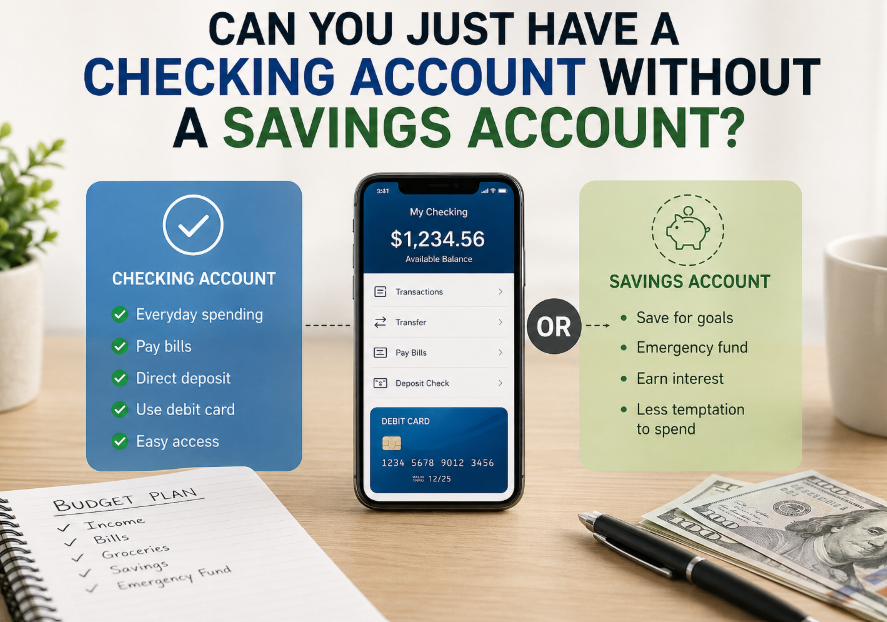
If you have extra money, want an emergency fund, or need help separating spending from saving, opening a savings account later can be a smart move.