
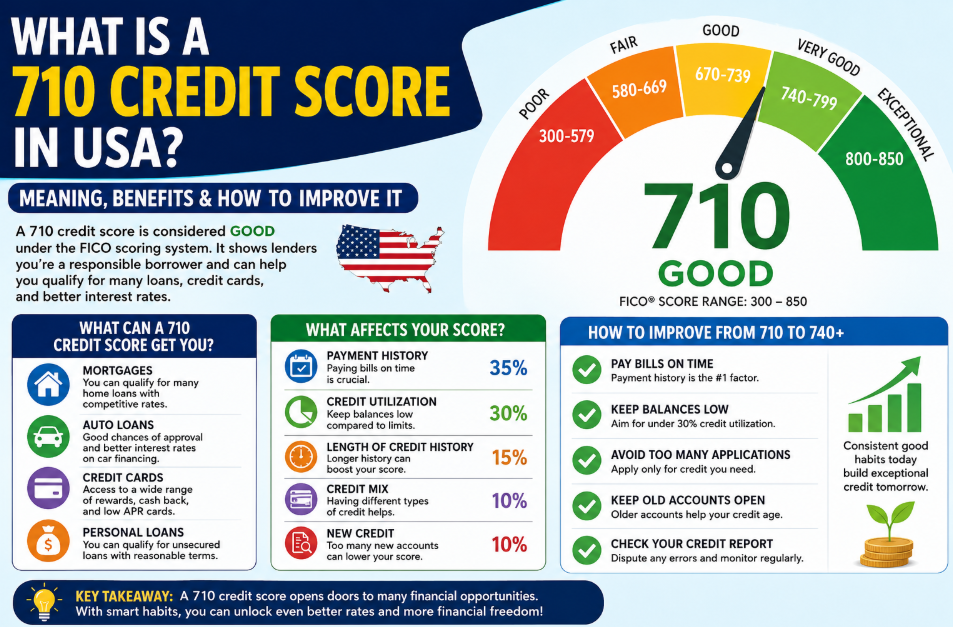
If you have checked your credit and found a 710 credit score, the first question is usually pretty simple: is that actually good?
Yes. A 710 credit score in the USA is generally considered a good credit score, particularly under the widely used FICO scoring system. It sits comfortably above the line separating fair credit from good credit, which means many lenders are likely to view you as a relatively dependable borrower.
But “good” does not necessarily mean “best.”
Think of a 710 credit score like having a solid seat near the front of the plane. We are definitely not stuck in the back, but we have not quite reached first class either. A 710 can potentially qualify us for mortgages, auto loans, credit cards, personal loans, and other financial products, yet borrowers with higher scores may sometimes receive lower interest rates or better promotional offers.
So, what is a 710 credit score in USA terms, what can we realistically qualify for, and is it worth trying to raise it?
Let’s break it down.
Is a 710 Credit Score Good in the USA?
A 710 credit score is generally classified as Good under the FICO credit scoring model.
FICO scores commonly range from 300 to 850, with higher scores indicating lower predicted lending risk. Experian identifies FICO scores between 670 and 739 as Good, placing a 710 comfortably inside this category.
A typical breakdown looks like this:
| Credit Score | General FICO Rating |
|---|---|
| 300–579 | Poor |
| 580–669 | Fair |
| 670–739 | Good |
| 740–799 | Very Good |
| 800–850 | Exceptional |
At 710, then, we are doing quite well.
We have already crossed an important psychological and financial threshold: lenders are less likely to immediately view the credit profile as high-risk.
Still, credit decisions involve more than one number.
The Consumer Financial Protection Bureau (CFPB) explains that lenders can use different scoring models and different versions of credit scores depending on the financial product involved.
In other words, the 710 we see through one app may not be exactly the score a mortgage lender sees.
What Does a 710 Credit Score Tell Lenders?
Credit scores are essentially risk predictions.
They help lenders estimate how likely we are to repay borrowed money according to the agreed terms. The CFPB notes that banks, credit card companies, and other businesses use credit scores when deciding whether to offer credit and what terms to offer.
A 710 score generally suggests that we have handled credit reasonably well.
Our report might show:
- Mostly or entirely on-time payments
- Reasonable credit card balances
- Established credit accounts
- Limited recent negative information
- A manageable number of credit applications
- Some experience using revolving or installment credit
Does that guarantee loan approval?
No.
A lender may also consider income, existing debts, employment, down payment, debt-to-income ratio, loan amount, and other underwriting criteria.
The score opens the door. The rest of our finances determine how comfortably we walk through it.
How Strong Is a 710 Credit Score Compared With Other Scores?
A 710 score occupies an interesting middle ground.
It is significantly healthier than a 600 or 650 score, yet it remains below the 740 threshold that commonly marks the beginning of FICO’s Very Good category.
That distinction can matter.
710 vs 650 Credit Score
Moving from 650 to 710 represents a meaningful improvement.
A 650 score falls within the Fair FICO range, while 710 falls into Good credit territory.
Someone at 650 may encounter:
- Higher interest rates
- Smaller credit limits
- More restrictive loan terms
- Fewer premium credit card choices
- Greater difficulty qualifying with certain lenders
At 710, the lending landscape often becomes much wider.
710 vs 700 Credit Score
There is usually no dramatic difference between a 700 and 710 score.
Both fall in the Good category under the standard FICO ranges.
Still, lenders do not necessarily evaluate credit using broad consumer-facing categories alone. Some lenders establish their own pricing tiers.
That means ten points could matter in one underwriting system while making virtually no difference in another.
710 vs 740 Credit Score
This comparison is more interesting.
At 740, we enter the Very Good FICO range.
That does not mean lenders suddenly throw confetti when we cross from 739 to 740, but borrowers with stronger credit profiles may have access to more favorable pricing.
Experian notes that consumers who move from Good credit into the Very Good or Exceptional ranges may become eligible for better borrowing terms.
So if we already have 710, aiming for 740 can be a sensible next goal.
710 vs 800 Credit Score
An 800 score belongs to FICO’s Exceptional category.
At that level, credit is unlikely to be the weak part of most conventional applications.
But here is something worth remembering: we do not necessarily need an 800 score.
Credit scores are tools, not trophies.
If a 760 score gets us the same mortgage pricing as an 820 score from a particular lender, those extra 60 points may provide bragging rights but no meaningful financial savings.
Can You Get a Mortgage With a 710 Credit Score?
In many circumstances, yes.
A 710 credit score can put us in a reasonable position to apply for several types of U.S. mortgages.
But mortgages illustrate perfectly why we should never evaluate borrowing power solely through a credit score.
What Mortgage Lenders Look At Besides Credit
A mortgage lender may evaluate factors including:
- Gross income
- Employment stability
- Debt-to-income ratio
- Down payment
- Cash reserves
- Property type
- Loan-to-value ratio
- Recent delinquencies
- Collections or bankruptcies
- Overall credit history
Federal mortgage rules do not impose one universal credit-score requirement that every lender must use. The CFPB notes that creditors may evaluate different aspects of credit history and other underwriting factors when assessing ability to repay.
So two applicants with identical 710 scores can receive different outcomes.
Why a Higher Score Can Still Help With a Mortgage
Even when 710 is enough for approval, improving the score before applying could potentially help us obtain more favorable terms.
That matters because mortgages are large, long-term debts.
A seemingly tiny difference in interest rate can translate into thousands—or even tens of thousands—of dollars over many years.
If we are several months away from applying for a home loan, improving credit may therefore be worth the effort.
Can You Buy a Car With a 710 Credit Score?
A 710 credit score generally places us in a solid position when shopping for auto financing.
We may have access to financing from:
- Banks
- Credit unions
- Dealer financing departments
- Automaker finance companies
- Online auto lenders
Again, there is no magical universal rate attached to the number 710.
Our rate may depend on the vehicle, loan length, down payment, income, lender, whether the car is new or used, and broader market interest rates.
Should We Accept the Dealer’s First Loan Offer?
Usually, shopping around is worth considering.
When we have reasonably good credit, we may have enough bargaining power to compare multiple lenders rather than automatically accepting whatever financing appears on the first dealership worksheet.
Imagine walking into a market with only one seller. We have no idea whether the price is competitive.
Financing works much the same way.
Getting quotes from a bank, credit union, and dealership can give us a clearer picture of the actual market available to our credit profile.
What Credit Cards Can You Get With a 710 Credit Score?
A 710 score may qualify us for a broad selection of credit cards, depending on the issuer and the rest of our application.
Potential categories include:
- Cash-back cards
- Travel rewards cards
- Balance-transfer cards
- Cards with introductory APR promotions
- No-annual-fee rewards cards
- Some premium credit cards
However, a 710 score never guarantees approval.
Credit card issuers may consider income, existing relationships, recent applications, outstanding debt, and their own internal underwriting models.
Can You Get a High Credit Limit With 710?
Possibly, but the credit score is only one piece of the puzzle.
Credit limits may depend heavily on income, existing credit exposure, previous experience with the issuer, and outstanding debts.
Someone earning $150,000 with a 710 score could receive a completely different limit from someone earning $35,000 with the same score.
That illustrates an important lesson:
A credit score measures credit risk. It does not measure wealth.
Can You Get a Personal Loan With a 710 Credit Score?
A 710 credit score may provide access to a variety of unsecured personal loans.
Potential uses could include:
- Debt consolidation
- Home repairs
- Major purchases
- Emergency expenses
- Moving costs
- Medical bills
But we should pay close attention to APR, origination fees, repayment period, and total interest—not simply whether the lender says “approved.”
Approval can feel exciting, but borrowing expensive money is still expensive money.
A strong credit score works best when we use it to obtain favorable financing rather than as an excuse to accumulate unnecessary debt.
What Determines a 710 Credit Score?
A credit score is calculated from information contained in our credit reports.
The CFPB identifies factors commonly considered by scoring systems, including payment history, unpaid debt, the number and types of accounts, account age, credit utilization, recent applications, and serious negative events such as collections or bankruptcy.
With FICO scores, several broad categories have traditionally played important roles.
Payment History
Paying bills on time is crucial.
A history of late payments can damage our score because lenders naturally care whether previous lenders were repaid as promised.
The CFPB describes payment history as one of the most important elements in maintaining strong credit.
One Late Payment Can Matter
A payment reported 30 or more days late can potentially have a significant impact, especially when the rest of the credit profile is clean.
That is why autopay for at least the minimum payment can act like a financial seat belt.
We hope never to need it, but it can protect us from a costly mistake.
Credit Utilization
Credit utilization measures how much revolving credit we are using relative to our available limits.
Suppose we have:
- $10,000 in total credit card limits
- $2,000 in reported balances
Our overall utilization would be 20%.
Lower utilization is generally better than repeatedly running cards close to their limits.
The CFPB advises keeping balances low relative to limits and notes that experts often recommend staying at or below roughly 30% of total available revolving credit.
But we should not treat 30% as a target.
Using 29% is not necessarily ideal just because it sits under an arbitrary line. Lower reported utilization can often be healthier, provided we continue using credit naturally and responsibly.
Length of Credit History
Time matters.
A long-standing account tells a longer story than one opened last month.
Closing an old card simply because we rarely use it can sometimes shorten or otherwise alter parts of our credit profile over time, while also reducing available revolving credit.
That does not mean we should keep every card forever, particularly if a card carries an annual fee we no longer value. It simply means account closures deserve thought rather than impulse.
New Credit Applications
Applying for several accounts within a short window can influence our profile.
Credit-scoring systems may interpret a sudden burst of applications as increased borrowing demand.
The CFPB recommends applying only for credit we actually need.
Credit Mix
Having experience managing different kinds of credit can contribute to a well-established profile.
Examples include:
- Credit cards
- Auto loans
- Student loans
- Mortgages
- Personal installment loans
However, we should never take out a loan merely to create a prettier “credit mix.”
Paying interest unnecessarily to chase credit-score points is a little like buying gasoline simply to earn fuel rewards. The math can quickly become backwards.
Why Do I Have More Than One Credit Score?
This surprises many consumers.
There is no single universal credit score permanently attached to our identity.
The CFPB explains that we can have multiple scores because lenders use different scoring models, different credit-report data, and sometimes specialized models for specific financial products.
Our score could vary depending on:
- Equifax data
- Experian data
- TransUnion data
- FICO model version
- VantageScore model
- Mortgage-specific scoring model
- Auto-specific scoring model
- Credit-card-specific model
- The date the score is calculated
So if one app says 710 and another says 724, neither is automatically wrong.
They may simply be measuring slightly different things.
Is a 710 FICO Score Different From a 710 VantageScore?
Yes, potentially.
FICO and VantageScore are separate scoring systems.
While both frequently use a 300-to-850 scale, their formulas are not identical.
Therefore, we should always ask:
What scoring model produced this 710?
A free consumer app may show one scoring model while a lender relies on another.
For casual monitoring, either can help us identify general trends. But before applying for an important loan, it may be helpful to understand what type of score the lender is likely to evaluate.
How Far Is 710 From Excellent Credit?
Not very far.
Under common FICO categories, we need around 30 more points to reach the 740 threshold for Very Good credit.
That can make a goal like 710 to 740 feel much more manageable than imagining we must somehow jump straight to 800.
Yet credit improvement is not always linear.
Scores can rise five points one month, drop twelve the next, then recover later—even if we are behaving responsibly.
Balances may be reported on different dates. New accounts age. Hard inquiries become older. Credit limits change.
Credit scoring is a moving picture, not a frozen photograph.
How Can We Improve a 710 Credit Score?
At 710, the strategy should usually be conservative.
We do not need financial gymnastics. We need consistency.
1. Never Miss a Payment
Pay every account on time.
If possible, set automatic payments so at least the minimum amount due is covered.
Missing a payment while trying to optimize tiny scoring details would be like polishing the hood while forgetting to put oil in the engine.
2. Reduce Credit Card Balances
If utilization is elevated, reducing reported balances could help strengthen the profile.
For example, imagine we have:
$20,000 total credit limits
$8,000 reported balances
That equals 40% utilization.
If we reduce those balances to $2,000, utilization falls to 10%.
The change can make the credit profile look considerably less leveraged.
3. Pay Credit Cards in Full When Possible
Carrying a balance does not mean we are building credit more effectively.
The CFPB specifically notes that consumers do not need to maintain outstanding debt to obtain a good score, and paying balances in full can reduce interest costs.
That old myth deserves to disappear.
Interest is a cost—not a credit-building subscription fee.
4. Avoid Unnecessary Credit Applications
A shiny welcome bonus can look tempting, but stacking multiple applications right before applying for a mortgage may not be wise.
Think about the bigger financial objective.
If we plan to buy a home soon, preserving a stable profile may matter more than earning another 50,000 reward points.
5. Keep Older Accounts in Good Standing
Older accounts can help establish credit history.
If an old no-annual-fee card still serves a purpose, keeping it open may make sense.
Use it occasionally, pay it off, and monitor it for fraud.
6. Review Your Credit Reports
Credit-report mistakes happen.
An incorrect late payment, an account that does not belong to us, or inaccurate balance information can potentially hurt our profile.
The CFPB recommends reviewing credit reports and disputing errors when found.
7. Give Your Credit Profile Time
Sometimes the most underrated credit strategy is doing nothing dramatic.
Keep paying bills.
Keep balances manageable.
Let accounts age.
Avoid unnecessary applications.
Time can quietly do a lot of heavy lifting.
How Long Does It Take to Go From 710 to 750?
There is no fixed timeline.
One person might gain 40 points relatively quickly after paying down a heavily utilized credit card.
Another might need many months because the main issue involves limited account age or older negative information.
What matters is identifying why the score is 710.
If high utilization is the problem, reducing balances may produce relatively quick changes after updated balances are reported.
If a recent late payment is holding the score down, improvement may require more patience.
Negative payment-history information can generally remain on credit reports for up to seven years, although its influence can change as it becomes older and positive history accumulates.
Should We Try to Reach an 800 Credit Score?
We can, but it should not become an obsession.
An 800 score is impressive. It indicates an exceptionally strong credit profile under common FICO classifications.
Yet personal finance should ultimately be about building wealth and reducing unnecessary costs—not collecting credit-score points.
A person with:
- A 760 score
- No revolving debt
- A strong emergency fund
- Healthy retirement savings
- Stable income
may be in a far stronger financial position than someone with an 820 score and virtually no savings.
Your score matters.
It just is not your entire financial life.
What Can Hurt a 710 Credit Score Quickly?
Getting from 710 to 740 might take patience.
Dropping from 710 to the 600s, unfortunately, can sometimes happen much faster.
Potential problems include:
- Missing payments
- Maxing out credit cards
- Opening several accounts rapidly
- Defaulting on a loan
- Allowing accounts to reach collections
- Closing cards that dramatically increase utilization
- Identity theft or fraudulent accounts
- Errors appearing on credit reports
This is why protecting a good score can be easier than rebuilding one.
Avoid Treating Available Credit Like Available Money
If a credit card gives us a $15,000 limit, we have not suddenly become $15,000 richer.
We simply gained the ability to borrow $15,000.
That distinction sounds obvious, yet forgetting it is where many credit problems begin.
Does Income Affect a 710 Credit Score?
Income itself is generally not part of the traditional credit-score calculation.
We could earn $30,000 or $300,000 and theoretically have the same credit score.
However, income absolutely matters when applying for credit because lenders need to assess whether we can afford the payments.
This creates an important distinction:
Credit score = history of managing credit.
Income = capacity to support financial obligations.
Lenders often need both perspectives.
Can a 710 Credit Score Get the Best Interest Rates?
Sometimes—but not always.
A 710 score may qualify for competitive rates, yet the absolute lowest advertised rates are often reserved for applicants who meet a lender’s strongest credit and underwriting criteria.
That could involve:
- Higher credit scores
- Low debt-to-income ratios
- Stable income
- Strong down payments
- Specific loan amounts or terms
- Existing lender relationships
Experian notes that borrowers in the Good FICO range can qualify for many credit products but may not always receive the lowest available interest rates.
That is probably the most accurate way to think about 710.
Good access, but not necessarily peak pricing.
Is 710 Good Enough, or Should We Wait Before Borrowing?
That depends on what we are buying.
If we need a reasonably priced car for work today, postponing the purchase for a year merely to chase an 800 score might make little sense.
But if we plan to apply for a $500,000 mortgage in six months, improving our score beforehand could potentially be worth considerably more.
Ask three questions:
- Is the borrowing necessary now?
- Would a higher score meaningfully improve the loan terms?
- Can we improve the score without delaying an important financial goal?
Credit optimization should support our life—not put it permanently on hold.
What Is a 710 Credit Score in USA? Final Verdict
So, what is a 710 credit score in USA terms?
It is a good credit score that generally signals responsible credit management and can provide access to a wide range of mainstream financial products.
With 710, we may potentially qualify for mortgages, auto financing, personal loans, and numerous credit cards, although approval and pricing will depend on much more than the score alone.
The bigger opportunity lies just ahead.
Since 710 sits below the Very Good FICO range beginning at 740, improving our score by another 30 or more points may strengthen our borrowing position.
Fortunately, we do not need tricks.
Pay bills on time. Keep revolving balances reasonable. Apply for new credit selectively. Review credit reports. Allow positive history to age.
Credit building is less like winning a sprint and more like growing a tree. We water it consistently, protect it from unnecessary damage, and eventually enjoy the shade.
Frequently Asked Questions About a 710 Credit Score
1. Is 710 considered a good credit score in America?
Yes. Under commonly used FICO ranges, a score of 710 falls within the Good category of 670 to 739. It can make us eligible for many mainstream credit cards and loans, although the best available rates may sometimes require stronger credit or other favorable underwriting factors.
2. Can I buy a house with a 710 credit score?
Potentially, yes. A 710 score can be sufficient for many mortgage applicants, but lenders also consider income, debt-to-income ratio, down payment, credit history, property details, and other factors. The score alone never guarantees mortgage approval.
3. Can I get a car loan with a 710 credit score?
Yes, a 710 score can generally put us in a competitive position for auto financing. The actual APR will depend on factors such as the lender, vehicle, loan term, income, down payment, market rates, and the specific credit-scoring model used.
4. How can I raise my credit score from 710 to 750?
Focus on consistently paying bills on time, lowering credit card utilization, avoiding unnecessary new applications, preserving healthy older accounts when appropriate, and checking credit reports for mistakes. The exact improvement timeline depends on what is currently influencing the score.
5. Is there a big difference between a 710 and 750 credit score?
Both scores indicate relatively healthy credit, but 750 falls within FICO’s Very Good range while 710 falls within Good. Depending on the lender, a 750 score may improve the chances of receiving more favorable rates or terms. However, lenders use different pricing tiers, so the financial difference varies from one application to another.