
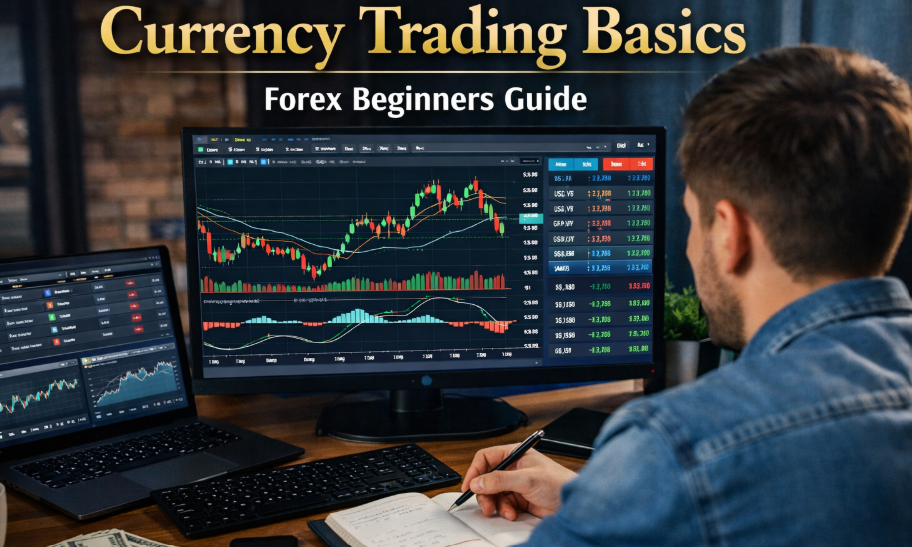
What Is Currency Trading and Why Does It Matter?
Currency trading—often called forex trading—is the process of buying one currency while simultaneously selling another. It sounds simple, right? But beneath that simplicity lies one of the most dynamic and liquid markets in the world.
Think of it like exchanging money at an airport—but on a massive, global scale. Instead of travelers, we have banks, institutions, and everyday traders like us.
Why does it matter?
Because currencies move constantly. And where there’s movement, there’s opportunity.
Understanding the Forex Market
What Does Forex Stand For?
Forex stands for “foreign exchange.” It’s the marketplace where currencies are traded.
Unlike stock markets, forex operates 24 hours a day, five days a week. It never truly sleeps.
How Big Is the Forex Market?
Let’s put it into perspective:
- Daily trading volume exceeds $6 trillion
- It’s larger than all stock markets combined
- It includes governments, banks, corporations, and retail traders
We’re essentially stepping into the largest financial arena on Earth.
How Currency Trading Works
Currency Pairs Explained
Currencies are always traded in pairs. For example:
- EUR/USD (Euro vs US Dollar)
- GBP/JPY (British Pound vs Japanese Yen)
When we trade, we are:
- Buying one currency
- Selling another at the same time
Base Currency vs Quote Currency
In EUR/USD:
- EUR = Base currency
- USD = Quote currency
If EUR/USD is 1.10, it means 1 euro equals 1.10 US dollars.
Types of Currency Pairs
Major Pairs
These involve the US dollar and major global currencies:
- EUR/USD
- USD/JPY
- GBP/USD
They are the most liquid and stable.
Minor Pairs
These exclude the US dollar:
- EUR/GBP
- AUD/NZD
Less traded, but still popular.
Exotic Pairs
These include emerging market currencies:
- USD/TRY
- USD/ZAR
Higher risk, higher volatility.
Key Forex Terminology You Must Know
Before diving deeper, we need to speak the language of the market.
Pips
A pip is the smallest price movement in a currency pair.
Spread
The difference between the buy (ask) and sell (bid) price.
Leverage
Allows us to control large positions with small capital.
⚠️ Powerful, but risky.
Lot Size
Represents the size of a trade:
- Standard lot = 100,000 units
- Mini lot = 10,000 units
- Micro lot = 1,000 units
How Traders Make Money in Forex
Buying (Going Long)
We buy when we expect a currency to rise.
Selling (Going Short)
We sell when we expect a currency to fall.
The beauty of forex? We can profit in both directions.
The Role of Supply and Demand
Currencies move based on:
- Economic strength
- Interest rates
- Political stability
- Market sentiment
It’s like a global tug-of-war between buyers and sellers.
Fundamental Analysis in Currency Trading
What Is Fundamental Analysis?
It involves analyzing economic data to predict currency movements.
Key Indicators to Watch
- Interest rates
- Inflation
- GDP
- Employment reports
For example, strong economic data often strengthens a currency.
Technical Analysis: Reading the Charts
What Is Technical Analysis?
It focuses on price patterns and historical data.
Common Tools We Use
- Trend lines
- Support and resistance
- Moving averages
- Candlestick patterns
Charts are like a story—if we know how to read them.
Trading Strategies for Beginners
1. Trend Following
We follow the direction of the market.
“Don’t fight the trend” isn’t just advice—it’s survival.
2. Breakout Trading
We enter trades when price breaks key levels.
3. Range Trading
We trade within support and resistance zones.
Risk Management: The Real Game-Changer
Let’s be honest—this is where most beginners fail.
Why Risk Management Matters
Without it, even the best strategy collapses.
Golden Rules We Follow
- Never risk more than 1–2% per trade
- Always use stop-loss orders
- Avoid over-leveraging
Think of risk management as your financial seatbelt.
Choosing a Forex Broker
What Makes a Good Broker?
- Regulation and security
- Low spreads
- Fast execution
- User-friendly platform
Popular Trading Platforms
- MetaTrader 4 (MT4)
- MetaTrader 5 (MT5)
Your broker is your gateway—choose wisely.
The Psychology of Trading
Why Emotions Can Destroy Trades
Fear and greed are the two biggest enemies.
We’ve all been there:
- Closing trades too early
- Letting losses run too long
How to Stay Disciplined
- Follow a trading plan
- Keep a journal
- Accept losses as part of the game
Trading is as much mental as it is technical.
Common Mistakes Beginners Make
Let’s call them out:
- Overtrading
- Ignoring risk management
- Chasing losses
- Trading without a plan
Avoiding these mistakes can put us ahead of 80% of traders.
Best Times to Trade Forex
Market Sessions
- Asian session
- London session
- New York session
The best opportunities often happen when sessions overlap.
How to Start Currency Trading Step by Step
Step 1: Learn the Basics
Understand how the market works.
Step 2: Open a Demo Account
Practice without risking real money.
Step 3: Develop a Strategy
Find what works for you.
Step 4: Start Small
Trade with minimal capital.
Step 5: Stay Consistent
Consistency beats quick wins.
Is Forex Trading Right for You?
Let’s be real—it’s not a get-rich-quick scheme.
It requires:
- Patience
- Discipline
- Continuous learning
But for those willing to commit, the rewards can be life-changing.
Closing Thoughts: Building a Strong Foundation in Forex
Currency trading is like learning a new language. At first, everything feels confusing—charts, terms, strategies.
But with time, it clicks.
We start seeing patterns. We understand movements. We develop intuition.
The key is simple:
- Learn deeply
- Practice consistently
- Manage risk wisely
And remember—success in forex isn’t about being right all the time. It’s about staying in the game long enough to win.
FAQs About Currency Trading Basics
1. Can beginners really make money in forex?
Yes, but it takes time, discipline, and proper risk management. Most beginners lose early due to lack of experience.
2. How much money do I need to start trading?
We can start with as little as $50–$100, but a larger capital base offers better flexibility and risk control.
3. Is forex trading risky?
Yes. High leverage increases both potential profits and losses.
4. Do I need a strategy to trade forex?
Absolutely. Trading without a strategy is like driving blindfolded.
5. How long does it take to become profitable?
It varies. For most traders, it can take months or even years of consistent learning and practice.