
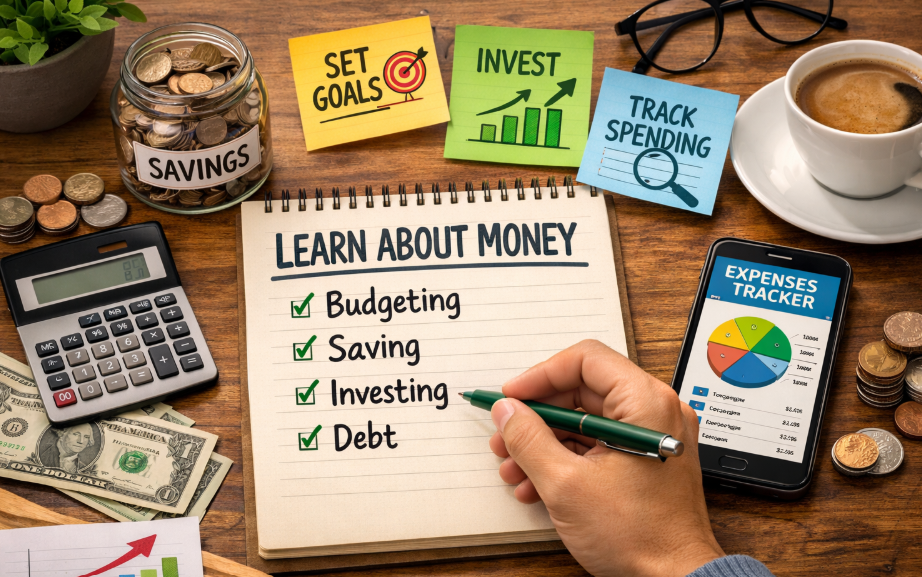
Money is one of those things we all use every single day… yet most of us were never truly taught how it works. It’s like being handed the controls of a plane without ever learning how to fly. So we figure it out mid-air—sometimes smoothly, often the hard way.
But here’s the truth: learning about money doesn’t have to be complicated, boring, or reserved for “finance people.” The best way to learn about money is practical, personal, and surprisingly simple when approached the right way.
Let’s break it down together—step by step—so we can actually understand money, not just survive it.
Why Learning About Money Matters More Than Ever
Money isn’t just numbers—it’s freedom, stress, opportunity, and sometimes regret all rolled into one.
When we don’t understand money:
- We live paycheck to paycheck
- We feel anxious about the future
- We make reactive decisions instead of intentional ones
When we do understand it:
- We gain control
- We build confidence
- We create options
Think of money as a tool. If you don’t know how to use it, it controls you. If you learn it, you control it.
The Biggest Myth About Learning Money
“You Need to Be Good at Math”
Let’s kill this myth right now.
Learning about money isn’t about solving complex equations—it’s about:
- Understanding behavior
- Building habits
- Making consistent decisions
In fact, most financial success comes from simple actions repeated over time, not genius-level calculations.
Start With the Basics (But Make Them Real)
What You Actually Need to Learn First
Instead of diving into complicated investing strategies, we start with fundamentals:
Income
Where your money comes from.
Expenses
Where your money goes.
Saving
What you keep.
Investing
How your money grows.
Debt
Money you owe (and how it affects everything).
These are the five pillars. Everything else builds on them.
Learning by Doing: The Fastest Way to Understand Money
Reading is helpful. Watching videos is helpful. But doing? That’s where the magic happens.
Track Your Money for 30 Days
This is where everything changes.
Write down (or use an app) to track:
- Every dollar you earn
- Every dollar you spend
You’ll start noticing patterns like:
- “Why am I spending so much on small things?”
- “I didn’t realize subscriptions were adding up”
Awareness = power.
Build a Simple Budget (That Actually Works)
Forget complicated spreadsheets. Keep it simple.
The 50/30/20 Rule
- 50% Needs → Rent, food, bills
- 30% Wants → Fun, entertainment
- 20% Savings/Investing
This isn’t about perfection—it’s about direction.
The Psychology of Money: Why We Spend the Way We Do
Money isn’t logical. It’s emotional.
We spend because:
- We’re stressed
- We want to feel rewarded
- We compare ourselves to others
Ask Yourself Before Spending
- Do I need this?
- Will this matter in a week?
- Am I buying this for me… or to impress someone?
Learning money = learning yourself.
Books vs Experience: Which Teaches Better?
Books Give You Knowledge
Great for:
- Concepts
- Strategies
- Inspiration
Experience Gives You Wisdom
Great for:
- Real consequences
- Emotional understanding
- Long-term habits
Best Approach? Combine Both
Read… then apply immediately.
The Power of Small Habits
We often think big changes lead to success. But with money, it’s the small things.
Examples of Tiny Habits That Change Everything
- Saving $5 a day
- Checking your account daily
- Avoiding impulse purchases
These seem small—but over time, they compound like interest.
Understanding Debt Without Fear
Debt isn’t always bad. But unmanaged debt? That’s where problems start.
Types of Debt
- Good Debt → Education, business (potential return)
- Bad Debt → High-interest credit cards, unnecessary loans
Golden Rule
If debt grows faster than your income, you’re in trouble.
How to Learn About Saving (Without Feeling Restricted)
Saving isn’t about deprivation—it’s about future freedom.
Make Saving Automatic
- Set up auto-transfers
- Treat savings like a bill
Start Small
Even $10/week builds the habit.
The goal isn’t the amount—it’s consistency.
Investing: The Game-Changer Most People Avoid
Investing sounds intimidating. But it’s simply making your money work for you.
Why Investing Matters
- Beats inflation
- Builds wealth over time
- Creates passive income
Start With Basics
- Index funds
- Long-term mindset
- Consistency over timing
The Role of Time in Money Growth
Time is the secret weapon.
The earlier we start:
- The less we need to invest
- The more we benefit from compounding
Think of it like planting a tree—the sooner you plant it, the more it grows.
Learn From Mistakes (They’re Inevitable)
Let’s be honest—we’re going to mess up.
Bad purchases. Poor decisions. Missed opportunities.
But Here’s the Key
Mistakes are tuition—not failure.
Every mistake teaches:
- What not to do
- What matters
- How to improve
Digital Tools That Make Learning Easier
We don’t have to do this alone.
Helpful Tools
- Budgeting apps
- Expense trackers
- Investment platforms
They simplify the process—but remember, tools don’t replace discipline.
Surround Yourself With Financial Awareness
Environment shapes behavior.
Do This Instead
- Follow financial educators
- Read money-related content regularly
- Talk about money openly
The more you expose yourself to it, the more natural it becomes.
Why Most People Fail to Learn About Money
It’s not lack of intelligence. It’s lack of consistency.
Common Reasons
- Overcomplicating things
- Trying to learn everything at once
- Not applying what they learn
Solution
Keep it simple. Stay consistent. Take action.
Create Your Personal Money System
There’s no “one-size-fits-all.”
Your System Should Include
- A way to track money
- A saving habit
- A simple investment plan
- Clear financial goals
This becomes your roadmap.
Set Clear Financial Goals (Or You’ll Drift)
Without goals, money disappears.
Examples
- Save $1,000 emergency fund
- Pay off debt in 12 months
- Invest monthly
Goals give your money purpose.
The Best Way to Learn About Money (Summed Up)
Let’s simplify everything we’ve discussed:
The Real Formula
- Learn the basics
- Track your money
- Build simple habits
- Apply what you learn
- Stay consistent
That’s it.
No complexity. No shortcuts. Just progress.
Closing Thoughts: Money Is a Skill, Not a Talent
We’re not born knowing how to manage money—we learn it.
And the beautiful part?
Anyone can learn it.
Step by step. Dollar by dollar. Decision by decision.
Think of money like a language. At first, it’s confusing. But the more you practice, the more fluent you become—until one day, it just makes sense.
And when it does? Everything changes.
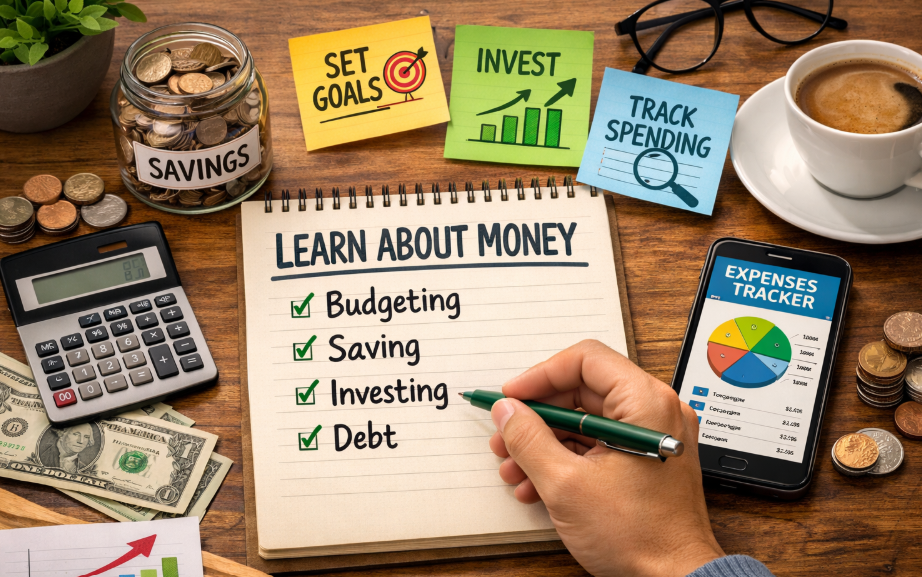
FAQs About Learning Money
1. What is the fastest way to learn about money?
The fastest way is hands-on: track your spending, create a simple budget, and apply what you learn immediately.
2. Can I learn about money without formal education?
Absolutely. Most financial knowledge comes from real-life experience, books, and consistent practice—not formal schooling.
3. How long does it take to understand money?
You can grasp the basics in weeks, but mastering money is a lifelong process of learning and adapting.
4. Is investing necessary to learn about money?
Yes. Investing is a key part of understanding how money grows and builds long-term wealth.
5. What’s the biggest mistake beginners make?
Overcomplicating things. Start simple and focus on consistency rather than perfection.